
Every facility manager has said some version of this: “We’re on a quarterly filter schedule, so we’re covered.”
Reasonable sentence. It also describes a different purchase than the one actually on the table. Here’s the mechanical reality. In a typical commercial air handler, return air travels through the return ductwork before it reaches the filter bank. Everything the building sheds moves through those lines unfiltered. The filter isn’t protecting the return side. It sits downstream of it.
My position: most buildings aren’t overpaying for the commercial duct cleaning Tampa FL vendors quote. They’re paying a fair price for a job that was never performed. The gap between a real scope and a vacuum held at the register is invisible on an invoice and obvious in the ductwork — and nobody checks the ductwork. Below: what a real scope contains, the evidence it leaves, and where honest contractors stop calling it cleaning.
The Filter Only Guards One Direction:
Air moves in a loop: return duct, filter, coil, blower, supply duct, room. The filter guards what’s behind it, not the ductwork in front, and not what has already settled inside. The EPA defines the system as supply and return ducts, registers, grilles and diffusers, heat exchangers, coils, condensate drain pans, fan motor and housing, and the air handler housing. A filter addresses none of them directly. Leave one contaminated and the rest re-contaminates fast, so HVAC cleaning Tampa buildings buy has to cover the whole loop. A partial job funds its own undoing.
Here, the Coil Never Fully Dries:
Air conditioning runs close to year-round here, so the cooling coil condenses moisture and the condensate pan holds water for nine months or more — not the seasonal cycle a system in Ohio gets. EPA guidance singles out cooling coils as a major moisture source precisely because they’re built to pull water from the air. Add the dust that arrives regardless and you have both ingredients microbial growth needs. A coil that never fully dries doesn’t need bad luck, just time. Which is why AC duct cleaning Tampa facilities schedule belongs on a recurring line.
What a Real Scope Contains:
Canada’s ACR Standard is specific enough to quote back at a bidder, and the association publishes a commercial checklist you can hand a vendor outright. Source removal means contaminants are agitated loose and extracted in the same motion; ACR doesn’t recognize chemical fogging or air washing alone. The system stays under continuous negative pressure throughout, so debris reaches the collection unit, not the occupied floor. Two more belong in the document: HEPA containment at every opening, filtering to 99.97% at 0.3 microns when equipment exhausts indoors, and coils, drain pans and the air handler as their own line items.
If a proposal for duct cleaning services Tampa FL buildings receive doesn’t name those, it’s quoting a different job.
Count the Access Panels:
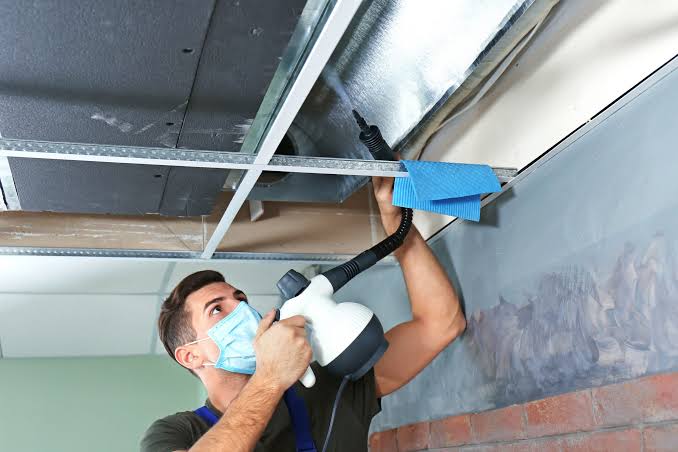
Reaching the inside of a duct means opening it. ACR requires service openings large enough for cleaning and verification, created without compromising the duct’s structural or thermal integrity, then closed properly. That leaves a physical artifact. Walk the ductwork after the crew leaves and count the new sealed access panels. If a 30,000-square-foot system was cleaned and there isn’t one, nobody reached the interior. They vacuumed what they could see through the registers.
Then ask for before-and-after imagery at named access points — “return riser, third floor east,” not generic duct photos — and whether a Certified Ventilation Inspector did the assessment. CVI is Canada’s credential and it’s verifiable.
Where Cleaning Stops and Remediation Starts:
Mold on bare sheet metal can be cleaned and treated. Mold in fiberglass duct liner cannot. EPA, NADCA and NAIMA all recommend replacing wet or moldy fiberglass duct material: cleaning won’t stop regrowth, and no EPA-registered biocide is approved for porous materials. Once growth is established in the liner you’re in commercial mold remediation Tampa territory, not a cleaning invoice. A contractor quoting a wash-down there is selling a result they can’t deliver. The one who says so unprompted is worth hiring.
Kitchens and Clinics Change the Scope:
Grease-laden vapor doesn’t stay over the range. It migrates into HVAC returns and films surfaces with residue ordinary agitation won’t lift, so the commercial kitchen cleaning Tampa operators arrange belongs in the same scope as the HVAC work.
Medical and dental suites carry accreditation weight, where documentation matters as much as the work. Both run after hours, zone by zone, on the logic behind any office cleaning Tampa scheduled around a working day.
FAQs:
Q1. How do I know if we need it?
Recognized triggers: dust streaking around supply registers, a musty note when the system kicks on, complaints clustering in one zone, weak airflow at diffusers. Any one justifies an inspection.
Q2. How often should a commercial system be cleaned?
NADCA sets intervals by building use, not the calendar: one to two years for healthcare and food service, two to three for schools, three to five for offices.
Q3. Does duct cleaning lower energy costs?
Sometimes, where debris was restricting airflow. A secondary benefit, not the reason to buy.
Q4. Can we stay open?
Yes, with containment and zone phasing.
Final Thoughts:
Filters and ducts are different purchases. Conflating them is how buildings pay for maintenance that never touches the problem.
Ask any bidder three questions: what’s your removal method, where are your access points, what does the verification report look like? The vent cleaning Tampa contractors doing this properly answer without hesitating, because the answers are just their process said out loud. Then count the panels. Worth reading what an HVAC and air duct cleaning engagement covers first.