

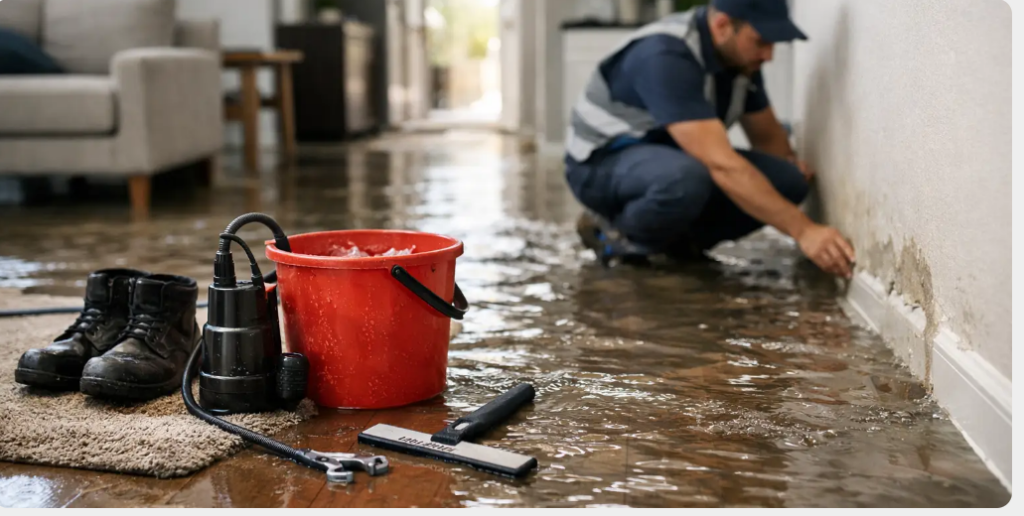
There was no name on the storm. No cone, no evacuation order, no week of coverage telling anyone to move the patio furniture. On the first Monday of August, ordinary rain put water over roads across Pinellas County — Snell Isle and Old Northeast in St. Petersburg, U.S. 19 in Clearwater — and into houses that had never taken water.
That’s what catches people. A property with no flood history and no claim on record can still take two inches of street water across the living room, because what put it there wasn’t a hurricane. It was an afternoon cell over ground that couldn’t absorb it.
Take one thing from this: the water leaving tells you nothing. That assumption turns a week of flood damage cleanup Tampa homeowners can manage into a demolition eighteen months on. Below, the first day, why street water differs from a burst pipe, and the one question that sorts real drying from fan rental.
The Drought Is Why It Flooded:
This sounds backwards, and most coverage skips it. The region sits under a Modified Phase III “Extreme” Water Shortage extended through October 1, with May’s rainfall deficit alone at 11.4 inches. Ground baked that long doesn’t drink, it sheds. Sun-hardened soil absorbs far more slowly than moist soil, so rain that would normally soak in runs off toward the lowest point on the block — often somebody’s front door.
It’s also falling in the wrong place. Tampa Bay Water’s chief science officer Warren Hogg has said the region needs sustained rain in the upper river basins to dent the drought. Coastal downpours flood streets without filling them, and the regional reservoir was recently near 15% of capacity. Tampa flooding and Tampa drought are one story this year, not two.
Your First 24 Hours:
- Kill the power at the breaker before stepping in, never while standing in water.
- Stop the intrusion if you safely can: sandbags, door dams, a tarp over a breach.
- Photograph before moving anything. Wide room shots, then close-ups with a tape measure against the wall showing water height. That evidence disappears once cleanup starts.
- Move what’s clean and light to a dry floor. Leave what’s saturated — dragging wet carpet and drywall through the house spreads contamination.
Then call emergency water damage restoration Tampa crews. The clock starts now, not when the water recedes.
Street Water Is Not Clean Water:
Under IICRC S500, water is graded by contamination. A supply-line break is Category 1. Street floodwater is Category 3, the most contaminated grade, covering ground surface water and classed as capable of carrying pathogenic agents. Consider what it crossed to reach you: roadway runoff, fertilizer, whatever the stormwater system pushed back up. Here’s what to know before anyone quotes you. S500 doesn’t permit porous materials soaked with Category 3 water to be dried in place. Carpet pad, insulation and the saturated band of drywall come out. So if a contractor offers to fan-dry your flood-soaked carpet, that’s not a bargain, it’s a bid that ignores the standard. Professional water extraction Tampa work treats Category 3 as decontamination first.
Ask What Your Dry Standard Is:
Restoration doesn’t dry to “feels fine.” It dries to a number. Crews read moisture in unaffected material of the same type elsewhere in the building, and that becomes the dry standard: the target wet material must hit before the job closes. Without it, nobody can say whether your wall is dry or just drier than yesterday. It sorts your bidders fast. A firm doing flood damage restoration Tampa properly has the reference reading, a moisture map, equipment on a documented plan, and verification readings. A firm that shrugs is renting fans.
It matters because water wicks up wall cavities, tracks under slab-on-grade flooring, and sits behind baseboards where nothing evaporates. In Tampa August it doesn’t leave, it relocates. The EPA puts mold growth on wet building materials within 24 to 48 hours.
When It Keeps Coming Back:
Some properties aren’t dealing with one event. Signal Cove residents have described standing water lingering for weeks after storms and even routine rain. Repeat intrusion becomes a building problem: chronically wet framing, failing subfloor, humidity no dehumidifier outruns. Then water damage repair Tampa pairs with drainage and grading work, or you pay to dry the same rooms yearly.
Insurance, briefly:
Standard homeowners policies typically exclude rising floodwater, and a new NFIP policy usually takes effect 30 days after purchase, with narrow exceptions for mortgage closings and recent map changes. Buying mid-storm doesn’t work. Confirm what you hold before the next system.
FAQs:
Q1. Is floodwater different from a pipe leak?
Yes. It’s Category 3, so saturated porous materials get removed rather than dried, and surfaces need sanitizing.
Q2. My floors feel dry. Am I fine?
Not necessarily. Wall cavities and subfloor hold moisture long after surfaces feel normal. A meter settles it.
Q3. What do I throw away?
CDC guidance is blunt: anything wet with floodwater that can’t be cleaned and dried within 24 to 48 hours goes outside. Photograph it first.
Q4. Do I have to move out?
Usually not for a contained loss. Heavy contamination is case by case.
Final Thoughts:
The tropics get busier from here and the ground is still hard. The next system won’t need a name to put water inside.
Photograph your interiors while they’re dry, confirm your flood coverage, clear the drainage around your foundation. If water gets in, treat it as contaminated, move in hours not days, and pick a water damage company Tampa FL homeowners can verify: one that answers the dry standard question without hesitating. Worth knowing what restoration and cleaning services cover before you need it.