
There’s a patch on most leather couches that’s darker and shinier than everything around it, usually at head height on the backrest. That’s body oil, and it’s the one spot nobody cleans — people wipe the seat cushions where the crumbs are and call it done. Left alone, that oil breaks down the protective topcoat until the color underneath starts lifting with it. Most of the ruined leather furniture we get called about wasn’t ruined by dirt. It was ruined by whatever someone grabbed to remove the dirt.
Vacuum before you wet anything:
Sand, pet hair, and grit collect in the seams. Wipe a damp cloth over that and you’re sanding the finish.
Brush attachment, slowly, along the seams and under the cushions. No beater bar — that rotating brush is too aggressive for leather. Two minutes here saves you the fine scratch pattern that shows up under lamplight a year later.
Test the leather before you wash it:
Put a drop of water on a hidden spot, low on the back panel. If it beads and sits there, you have protected (pigmented) leather, which is most leather sofas sold today. If it soaks in and leaves a dark ring within seconds, it’s aniline or semi-aniline. Stop there and call someone — water alone will mark it.
For protected leather, the method is boring and that’s the point:
- A few drops of gentle dish soap in warm distilled water. Distilled matters more than it sounds — hard water leaves faint mineral haze as it dries.
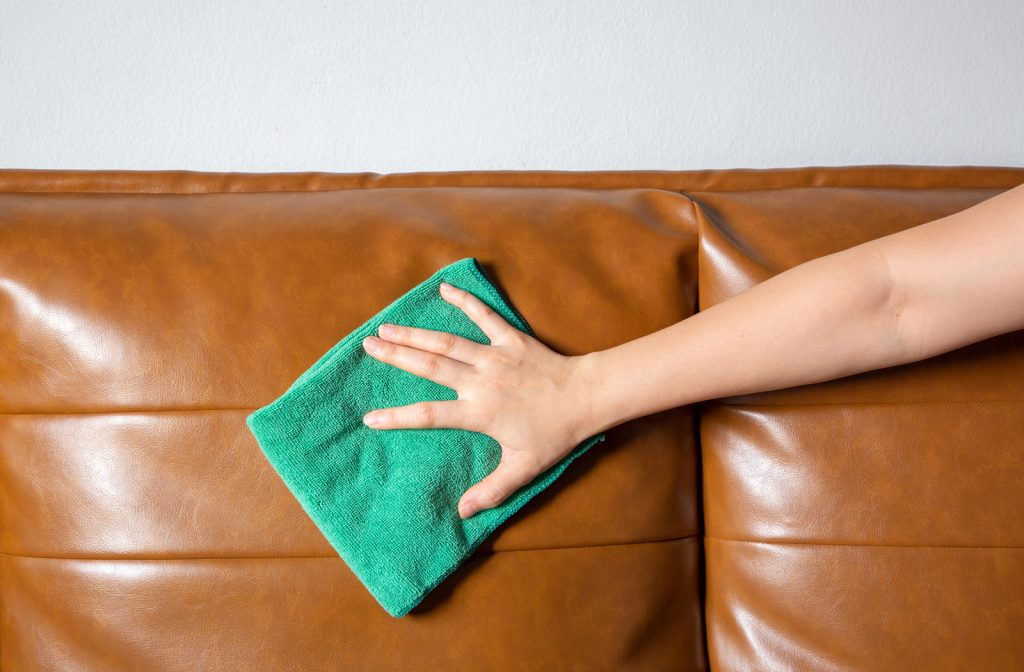
- Dip a microfiber cloth and wring it until it’s barely damp. Not wet. Damp.
- Work one cushion or panel at a time. Light pressure, no scrubbing.
- Go over the same section with a second cloth and plain water to lift the soap residue.
- Dry immediately with a third cloth, seams especially.
If you already own a dedicated leather cleaner, use it. It just won’t do anything the soap doesn’t. Never let water pool in a seam — that’s the path into the foam underneath.
The things that quietly wreck leather:
- Baby wipes. “Alcohol-free” on the label doesn’t save you. Wipes run alkaline, leather is mildly acidic, and the surfactants work on the topcoat a little at a time. This is the one we see most.
- Melamine sponges — the “magic eraser” kind. They clean by micro-abrasion, which on leather means sanding.
- Alcohol- or ammonia-based sprays. Most all-purpose cleaners qualify.
- Olive oil or coconut oil as a homemade conditioner. It darkens the leather unevenly, and a few months in it goes rancid inside the hide. Your couch ends up smelling faintly like an old kitchen.
They all look like they worked, which is the problem. The version we run into most: someone takes a magic eraser to one scuffed cushion, the scuff lifts, everybody’s pleased. Months later that cushion sits a shade lighter than the seven around it, because what came off wasn’t the scuff. It was the pigment. At that point it isn’t a cleaning job. It’s refinishing.
What Tampa does to leather:
Leather drinks moisture straight out of the air. Add body oils and a summer where indoor humidity sits north of sixty percent and you’ve built something mildew likes — usually the back panel of a couch shoved flat against an exterior wall, or a guest room nobody opens.
Pull the couch a few inches off the wall and let air move behind it. If you smell something musty and surface cleaning doesn’t touch it, the problem isn’t the leather — it’s the foam and the frame, and that’s when professional furniture cleaning beats another round of wiping.
Condition less often than the internet tells you:
Twice a year, thin coat, conditioner made for finished leather. In Arizona, leather cracks from dryness. Here the failure runs the other way: over-conditioned leather goes tacky, grabs dust, and holds humidity against the surface. If it still feels slick the next day, you used too much.
A couch that gets vacuumed monthly and wiped down twice a year will outlive one that gets deep-cleaned in a panic every time something spills on it. Leather in Tampa rarely dies of neglect. It dies of enthusiasm.