

Pull up a floor vent and look at the cut edge of the plank. You’ll see a thin stripe of real wood on top of a stack of plywood layers. That stripe is your whole floor, and its thickness decides almost everything about how you should treat it.
Most people never look. It takes ten seconds and tells you more than anything else about your own floor.
How much floor do you actually have:
Engineered planks are a veneer of hardwood bonded to a plywood or fiberboard core. The veneer, called the wear layer, runs anywhere from about 0.6mm on budget floors to 6mm on the expensive stuff.
Sanding removes roughly 1mm each time, which is the whole arithmetic. At 1mm or under, the floor can only ever be recoated, never sanded. Around 2mm buys one careful refinish, and the National Wood Flooring Association treats anything under about 2.5mm as effectively unrefinishable. Over 3mm you have two or three cycles in reserve.
If you’re on the thin end, and most budget floors are, routine cleaning isn’t maintenance. It’s the entire maintenance plan. A stair nosing or a door threshold shows the same stripe, and if you still have the spec sheet it’s printed there.
The seams matter more than the surface:
Solid wood swells and shrinks as a whole board, which is why it cups. Engineered resists that well, which is exactly why people get relaxed with it. But the plies are held together with glue, and so is the veneer on top. Water sitting in a seam wicks into the core, swells the layers at different rates, and lifts the edge of the plank.
That damage doesn’t dry out and flatten back down. Once the edges have swelled, the plank is finished. You replace it or you live with it, which is why advice written for solid floors can quietly get you into trouble here.
So the rule is simple, if unsatisfying: nothing wet ever sits still on this floor. Not a spill you’ll get to in a minute, not a dog bowl that splashes, not a mop that leaves shine behind it.
A note on the marketing. Plenty of these floors are sold as waterproof, and the plank may well be. The seams and the subfloor are not. Waterproof buys you time to wipe a spill up. It doesn’t change where standing water ends up.
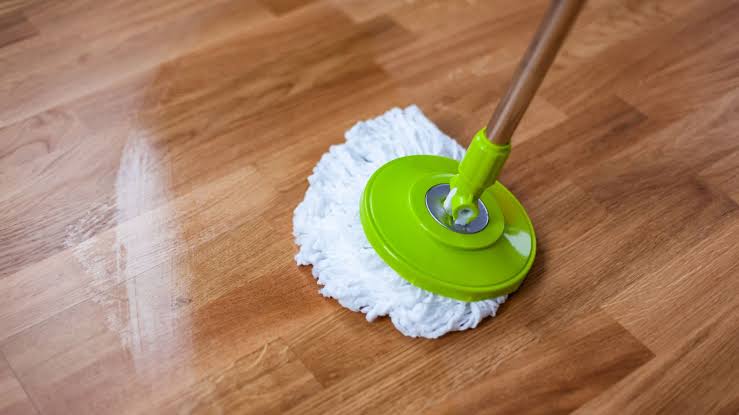
The routine, which is duller than you’d like:
Dry work first, every time. Vacuum with the hard floor head or a dry microfiber pad, and get the grit out before anything damp touches it.
For the wet pass, use a cleaner labeled for engineered or finished hardwood, pH neutral. Spray it on the mop pad instead of the floor, work in small sections, and watch the surface behind you. If it’s still wet after thirty seconds, you’ve used too much.
Skip steam entirely, including the mops advertised as safe for sealed floors. Vinegar is acidic and dulls the finish over time. Oil soap leaves a residue that stops any future recoat from bonding. And the wet string mop your grandmother swore by holds more water than this floor can shed.
Once a week is plenty. Sweeping is the part that should happen more often.
When the edges start to lift:
If planks are cupping at the seams, feeling spongy, or showing a dark line along the joints, the water is coming from somewhere other than your mop.
In Tampa that’s often the slab underneath. Plenty of engineered floors here float over concrete with a vapor barrier between the two. If that barrier was skipped, or got torn during the install, moisture works up into the back of the plank where nothing you do on top will ever reach it. Dishwashers and refrigerator lines account for most of the rest. By the time the edges show it, we’re usually looking at more planks than the homeowner expected.
That’s a moisture problem, not a cleaning one, and it’s worth a water damage restoration assessment before it spreads past the planks you can still replace.
A solid floor gives you second chances. Engineered gives you one, and it’s spending it right now.