

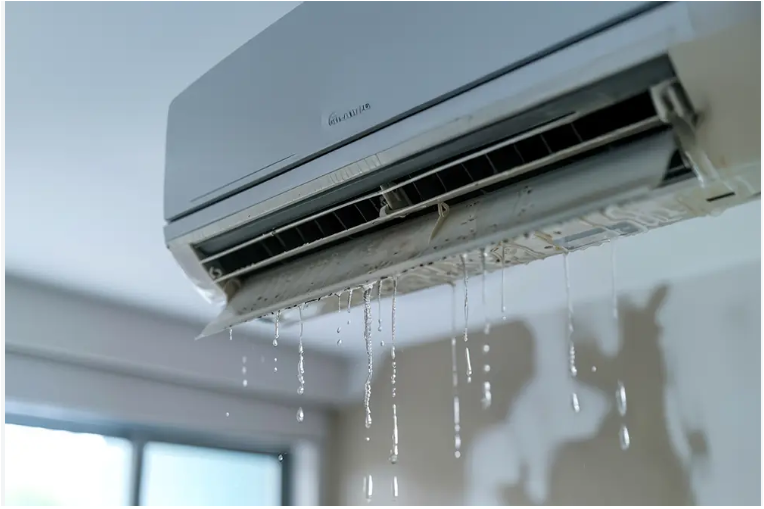
Your air conditioner is supposed to produce water. That’s most of what it does in a Tampa summer — pulling moisture out of the air and sending it outside, five to twenty gallons a day in this climate. So the unit isn’t leaking because it made water. It’s leaking because the water can’t get out.
That distinction matters, because it narrows the problem to about three things, and two of them you can check yourself in ten minutes.
Turn it off first:
Before diagnosing anything, shut it down at the thermostat and the breaker.
Every minute it runs, it makes more condensate, and every drop goes wherever the last one went. A leak you find at 7am and investigate at noon has spent five more hours soaking into the same patch of ceiling.
If your AC has already shut itself off and there’s water present, that’s probably a float switch doing exactly what it was installed to do. Leave it off.
In July you’ll want to know whether you can run it anyway. Fan-only is fine and helps dry things out. Cooling isn’t, until the water has somewhere to go.
The drain line, most of the time:
Your evaporator coil drips into a pan, and the pan drains through a PVC line running outside. In Florida that line is a warm, wet, dark tube — an excellent home for algae. It clogs. The pan fills. The pan overflows.
You can usually clear it yourself. Find where the line exits outside — a white PVC stub near the condenser or the foundation — and hold a wet/dry vac to it for two or three minutes. What comes out will be unpleasant, and it confirms the diagnosis.
Then keep it clear. A cup of distilled white vinegar down the access port — the capped T-fitting on the line near the air handler — every month or two, through the dry season too, costs almost nothing and prevents most of these calls.
When it’s ice, not a clog:
If the drain runs clear and you’re still finding water, look at the coil. A frozen evaporator melts all at once when the system cycles off, and that volume overwhelms a pan built for a drip.
A filter nobody’s changed in six months chokes the airflow across the coil and it ices over. That one’s yours to fix. Low refrigerant produces the same ice for a different reason, and that one needs a tech — refrigerant runs in a sealed loop, so low means it’s escaping somewhere.
Either way, switch to fan-only for a few hours to thaw it before anyone opens anything up.
If it’s neither:
A drain pan rusts through eventually, and on attic units the secondary pan underneath can crack or drift out of level — at which point it’s catching water and quietly delivering it to your ceiling.
Both are a flashlight check, and both are a replacement rather than a repair.
The question nobody asks:
The part that actually costs money is what’s already happened above the ceiling.
Ask how long it’s been going. A ceiling stain with a darker ring around the edge has been wetting and drying repeatedly. Drywall that gives under a thumb is saturated. A musty smell near the return vent means it’s in the insulation, and blown-in insulation holds water like a sponge and dries like a brick.
The leaks we get called to are almost never the ones that started that morning. They’re the ones somebody noticed weeks ago, put a bucket under, and meant to deal with.
Condensate starts clean, but it sits in a pan with biofilm in it, and in a Tampa attic wet material gets very little grace period. Drying it properly is the whole game, and a box fan pointed at a ceiling doesn’t reach insulation or the cavity behind the drywall.
That’s what water damage restoration equipment is built for: pulling moisture out of materials rather than off their surface. It’s the difference between fixing this once and finding it again next summer.
Get the AC fixed this week. That’s the small number. The ceiling above it is the one that decides what this actually cost.