
The fastest way to wreck a hardwood floor in Tampa is to buy a steam mop and use it exactly as instructed.
Steam forces hot vapor down through the seams between boards, where the finish doesn’t reach. The surface looks immaculate. Underneath, water is going into wood that already lives in one of the wettest climates in the country, where outdoor humidity averages around seventy-four percent and the indoor air chases it every time the AC cycles off. Bruce, Mohawk, Bona and the National Wood Flooring Association all tell you not to do it, and most manufacturers treat it as grounds for voiding the finish warranty.
You’re cleaning finish, not wood:
Almost nobody is actually cleaning wood. What your mop meets is a layer of polyurethane roughly as thick as a sheet of paper. That’s the entire barrier between your floor and everything that happens in the room.
Once you picture it that way, the rules stop being arbitrary. Vinegar is a mild acid, and mild acids dull polyurethane a little at a time until the whole floor reads flat under a window. Oil soap leaves a residue that looks great for a week, then builds up — and when you eventually pay someone to recoat, the new finish won’t bond to it. Refinishers can tell within a minute what you’ve been mopping with.
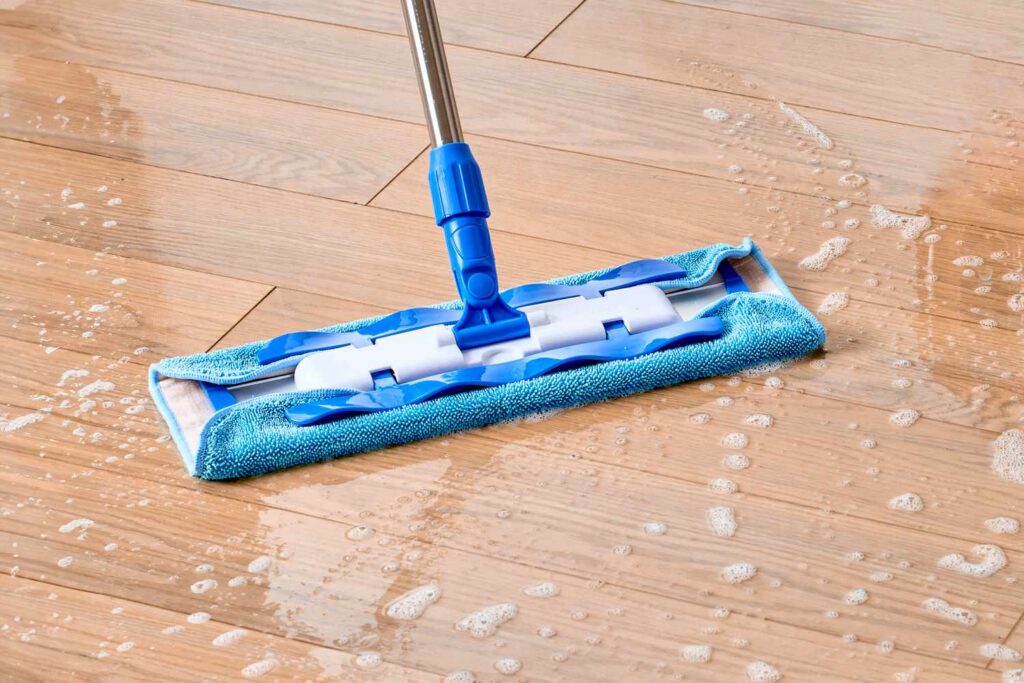
Use a cleaner made for finished wood floors, spray it on the mop pad rather than the boards, and stop shopping for anything more exciting than that.
Engineered wood and most laminate fall under the same rules. The finish on top is the same product; the wear layer beneath it is thinner. That buys you less margin for error, not more.
Sand does more damage than dirt:
Florida sand is quartz. Quartz is far harder than floor finish, which means every grain tracked in from the beach or the driveway is doing the work of very fine sandpaper under someone’s heel.
This is why the dull traffic lane in front of the couch shows up years before anything else. Nobody spilled there. People just walked.
Sweep or dry-mop more often than you clean, put a coarse mat outside the door and an absorbent one inside, and take the shoes off. Three ordinary habits that will matter more in ten years than anything on the shelf.
How damp is “damp”:
Every article says damp mop. Almost none of them tell you what that means, so here’s a test you can actually run.
Wring the mop until it can’t drip when you hold it up. Run it over a section and watch. The floor should look dry in under a minute. If there’s still a visible sheen at thirty seconds, you’ve put down more water than the finish can shed, and the excess is heading for the seams.
Work in small sections and finish each one before moving on. Never let water stand along the baseboards, where the gap at the wall gives it somewhere to go.
Once a week is plenty for most rooms. It’s the sweeping that should happen more often than feels necessary.
When it isn’t dirt:
Sometimes a floor stops looking right and no amount of cleaning helps. Check the boards edge-on, low, with light coming across them.
If the edges of the planks sit higher than their centers, that’s cupping, and it means moisture is coming from underneath: a slab without a vapor barrier, a slow supply line, or the one we find most often, an AC condensate drain that’s been overflowing quietly for a month. Older Tampa homes are especially prone to the slab version.
Cupping isn’t a cleaning problem and it doesn’t dry out on its own in this climate. It’s the point where a water damage assessment is worth more than another pass with the mop, because the wood will keep drinking whatever is feeding it.
Scuffs and dull patches are cosmetic; you have years to get to those. Moisture from below is on a schedule, and it isn’t yours. In a climate like this one, the question was never how clean your floors are — it’s how much water you keep handing them.