
Somebody has handed you a number for the lobby. Tear out the floor, haul it away, pour new, and the quote has a comma in it you weren’t expecting.
Run the arithmetic first. New poured terrazzo runs roughly $5 to $15 a square foot in material plus $10 to $20 in labor, with demolition on top. Call it $20 to $40 installed. Restoring the floor you own typically lands between $5 and $12. On a 3,000-square-foot lobby that’s $60,000 to $120,000 against $15,000 to $36,000.
So why the teardown quote? Replacement is the easier sale. Ripping out a floor takes no judgment about what’s underneath. Restoration takes somebody to assess the substrate, call the remaining thickness, and be right. The terrazzo restoration Tampa owners consider is usually the better buy, and occasionally it genuinely isn’t. Below is how to tell which you have, including one thing you can check yourself in thirty seconds.
Worth Saving, or Not:
Four signals say restore:
- The material is sound under the wear
- Damage sits in the surface layer, not through it
- Wear concentrates in traffic lanes rather than spreading uniformly
- Nothing is moving or cracking in the substrate below
The ones that say stop are just as clear. A failed substrate isn’t a flooring problem, it’s a structural one, and grinding a floor on moving concrete buys a smoother version of the same crack next year. Widespread cracking, delamination, or a floor ground past its usable thickness are replacement conversations. A contractor who won’t name that boundary is telling you how they sell.
Go Look at Your Divider Strips:
This check costs nothing and nobody tells the owners about it.
Those metal lines aren’t only decorative. They align with the slab’s control joints, they match the system’s specified thickness, and installers use them as the grinding gauge: when the strips begin to show, the operator knows he’s cut to depth. A built-in measuring stick.
Walk the lobby and feel them underfoot. Flush means material is left. Strips standing proud mean the floor has been ground to or past its reference, with little above the aggregate to work with.
And the number that surprises people: NTMA specs epoxy terrazzo as a nominal quarter-inch to three-eighths veneer, with cement systems carrying a half-inch topping. Not inches. Every grind spends a fraction of that, permanently.
What Restoration Means, Material by Material:
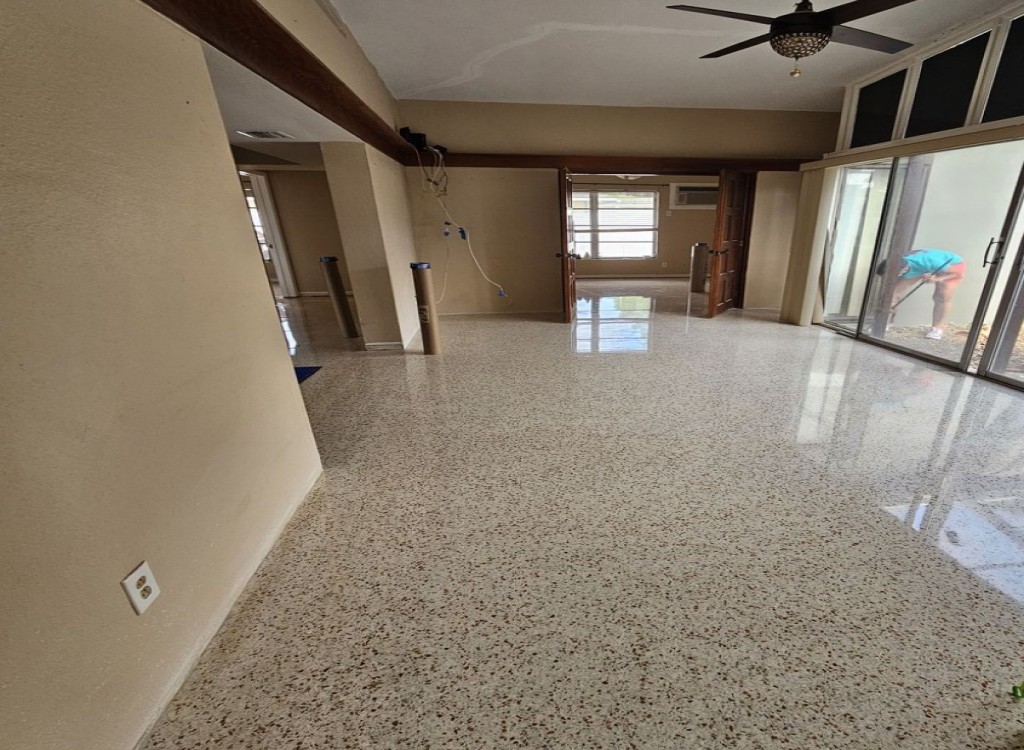
Terrazzo. Diamond grinding through finer grits, then honing and polishing to the specified sheen, with crack filling and color-matched chip repair, then densifier and sealer.
Marble. This is what most owners get wrong. Marble is calcium carbonate, and the Natural Stone Institute is direct: it reacts with acids, so only mild non-acidic cleaners belong on it. Those dull patches usually aren’t dirt. They’re etch marks, where acid dissolved the polished surface, and no cleaning brings it back. The marble restoration Tampa buildings need is mechanical: hone past the damage and repolish. Which is why the marble cleaning Tampa crews perform matters — the wrong bottle creates the problem it appears to fix.
Travertine. Full of natural voids, so restoration means filling and honing, not scrubbing harder. Where travertine cleaning Tampa crews go too aggressive, those voids open further.
Concrete. Polished slabs fail when the sealer is stripped rather than maintained. Good concrete cleaning Tampa practice protects it; strippers expose the slab.
The Grout Is Usually the Complaint:
Before budgeting anything, look at what actually reads as dirty. A lobby usually photographs badly because of dark grout lines, not the tile between them. Grout is porous, sits below the tile surface where soil collects, and discolors long before the tile wears. Competent tile and grout cleaning Tampa work fixes the appearance at a fraction of restoration pricing. One warning: many grout cleaners are acidic. Use them on grout surrounded by marble or travertine and you fix the grout while etching the stone.
Why Gulf Coast Floors Dull Faster:
Parking lot grit here is angular silica and crushed shell, not soft soil. Tracked across polished stone it works like sandpaper, cutting micro-scratches that scatter light, and that scattering is what “dull” actually is. The rainy season drives it deeper on wet shoes. An honest commercial cleaning Tampa FL program answers with matting and frequency, not stronger chemistry.
Your Janitorial Crew Decides How Long It Lasts:
The work runs zone by zone, after hours, with dust containment, on the phasing logic behind any commercial cleaning scheduled around a working day. Budget cure time: a floor that looks finished at 4 a.m. may not be ready for heels at 8.
Then it’s daily habits. Give your office cleaning Tampa provider three instructions in writing: pH-neutral cleaners only, nothing acidic near stone, matting long enough for several footfalls. Hold the sealer interval your contractor specifies and the floor outlives the lease.
Five Questions Before You Call Anyone:
- Is the substrate sound, or is something moving underneath?
- Are the divider strips flush, or standing proud?
- Is the wear in lanes, or across the whole floor?
- Is it the tile that looks bad, or the grout?
- What is my janitorial crew actually putting on it?
FAQs:
Q1. How long does a restoration take?
Most lobbies run two to five overnight shifts, phased by zone so the building stays open.
Q2. How many times can terrazzo be ground?
Depends on what’s left. The divider strips are your evidence.
Q3. How long will a restoration last?
Years, not months, and the variable is maintenance rather than the grind. Sealer upkeep and matting decide whether you’re back in three years or fifteen.
Q4. Can you restore just the traffic lanes?
Rarely to an invisible result. Blending back to the untouched field is the hard part.
Final Thoughts:
Most Tampa lobbies are worth more than the quote to remove them suggests. Terrazzo, marble and concrete were designed to be refinished, and the original is often better than what replaces it.
Check the strips, then get an assessment naming substrate condition and remaining thickness before anyone prices a teardown. Any property restoration Tampa contractor who calls a sound floor finished is quoting the easier job.